
OrbLit vs. Connected Papers — one growing map vs. a graph per paper
This page compares OrbLit and Connected Papers for anyone deciding between the two. Connected Papers excels at exploring the neighborhood of one paper at a time, with no account required. OrbLit is built around one persistent map of your whole collection instead — the right choice depends on which of those two workflows matches how you actually work.
Feature comparison
| OrbLit | Connected Papers | |
|---|---|---|
| Price | Free, open source | No account needed, 5 new graphs/month free · Academic from $5/mo, Business $15/mo (billed quarterly) |
| Zotero sync | Import a whole collection + add papers back to Zotero (incl. PDF), one click | Export only, to Zotero/Mendeley/EndNote — no import or ongoing sync |
| Thematic clusters | Yes, a dedicated Themes map for your whole collection | Yes, a core feature — similarity-based clustering around a single origin paper |
| Citation network visualization | Yes — one persistent, growing map of your collection | Yes, but scoped per graph: one origin paper per graph, not a standing collection view |
| Data source | OpenAlex (primary), with Semantic Scholar / Crossref abstract fallback | Semantic Scholar |
| Collaboration / sharing | Not available | Limited — saved papers and graph history, no shared or monitored collections |
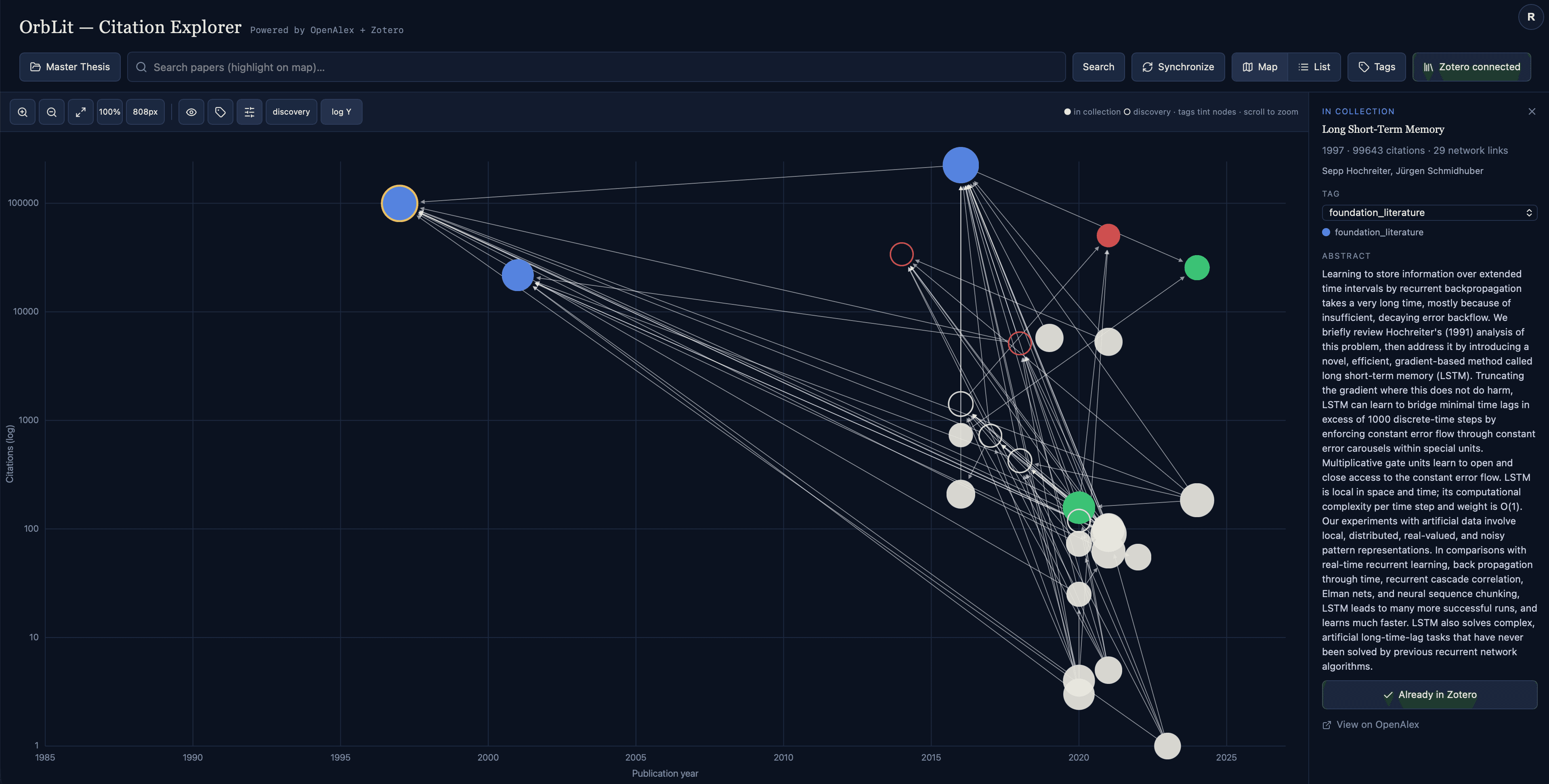
OrbLit's citation network map — filled nodes are papers already in your collection, outlined nodes are discovery papers found around it.
When Connected Papers is the better choice
- — No account needed at all, up to the monthly graph limit — the fastest possible way to explore a single paper's neighborhood.
- — It's sharply focused on one thing (exploring around one origin paper) and does it fast, without any collection setup.
- — It's been around longer with broad recognition in the academic community.
When OrbLit is the better choice
- OrbLit builds one persistent, growing map of your whole collection instead of a separate graph per origin paper — closer to how an actual literature review works than exploring one paper's neighborhood at a time.
- Zotero goes both ways — import a whole collection and add papers straight back into Zotero (with the PDF). Connected Papers can only export to Zotero, not import or sync from it.
- Thematic clustering applies across your whole collection, not just the papers similar to a single origin paper.