
OrbLit vs. ResearchRabbit — two-way Zotero sync vs. free-forever collaboration
This page compares OrbLit and ResearchRabbit for anyone deciding between the two. ResearchRabbit is free with no real cap on core use, and OrbLit is free and open source. The real trade-off isn't price — it's how each tool connects to Zotero and whether you need to collaborate with others.
Feature comparison
| OrbLit | ResearchRabbit | |
|---|---|---|
| Price | Free, open source | Free Forever (unlimited searches/collections, 50 seed papers/search) · RR+ from ~$10/mo |
| Zotero sync | Import a whole collection + add papers back to Zotero (incl. PDF), one click | One-way import only (Zotero Importer); true two-way sync is, per their own docs, still in development |
| Thematic clusters | Yes, a dedicated Themes map view, automatic via embeddings + clustering | Some visual grouping within the network maps |
| Citation network visualization | Yes — interactive map built from citations & references | Yes, a core feature (earlier/later/similar-work maps) |
| Data source | OpenAlex (primary), with Semantic Scholar / Crossref abstract fallback | Semantic Scholar and OpenAlex |
| Collaboration / sharing | Not available | Yes — shared collections, included free, a core feature |
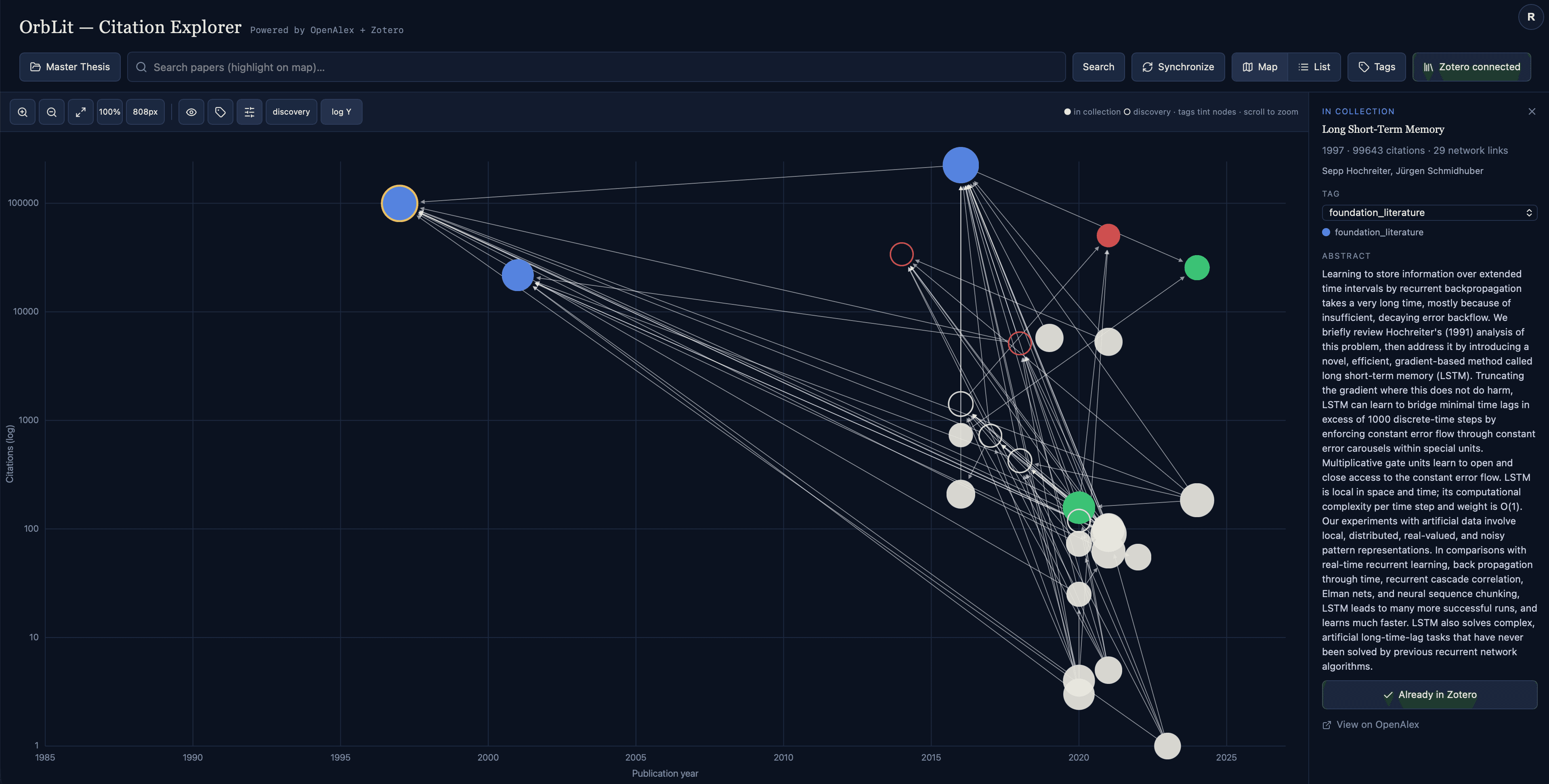
OrbLit's citation network map — filled nodes are papers already in your collection, outlined nodes are discovery papers found around it.
When ResearchRabbit is the better choice
- — It's genuinely free with no map/paper cap on core use — its Free Forever tier covers most individual literature-review workflows outright.
- — Shared collections and collaboration are built in and free — OrbLit doesn't have a collaboration feature yet.
- — It has a larger, more established user base in academic circles.
When OrbLit is the better choice
- OrbLit's Zotero integration already goes both ways — import a whole collection and add papers straight back into Zotero (with the PDF). ResearchRabbit's Zotero Importer is currently one-way only; a real two-way sync is, per their own docs, still in development.
- Build the map directly from a Zotero collection you already have, instead of hand-picking or searching for seed papers.
- Thematic clusters live in their own dedicated map view, not just an implicit layout inside the citation network.